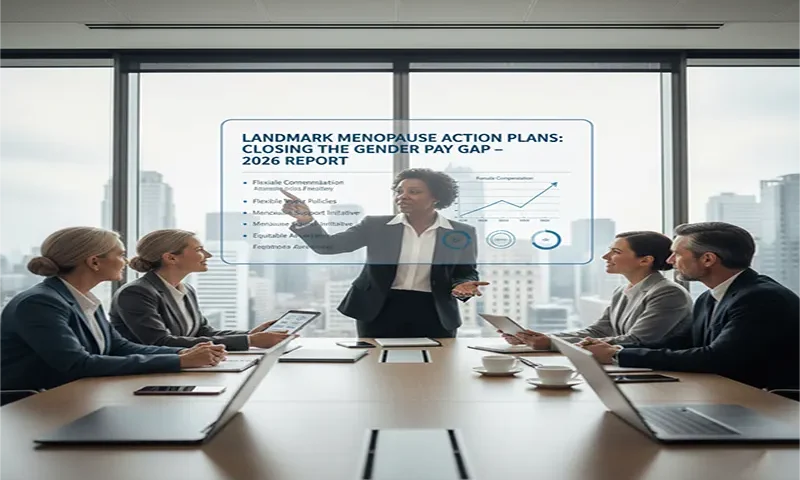
Beyond Policy: How Landmark Menopause Action Plans are Closing the Gender Pay Gap in 2026

By 2026, the corporate narrative around women’s health has undergone a seismic shift. For decades, the “Menopause Cliff”—the career stage, typically in a woman’s 40s or 50s, where symptoms often coincide with the transition into senior leadership—was treated as a private health matter. Today, however, it is recognized as a pivotal economic concern. Landmark Menopause Action Plans are no longer just “nice-to-have” wellness perks; they are essential economic strategies being deployed to stop the mid-career talent drain and actively close the gender pay gap.

The Economic Cost of Symptom Neglect

The gender pay gap is rarely the result of a single event; it is the cumulative effect of the “broken rung” in the corporate ladder. Research consistently shows that mid-career is where women are most likely to slow their progression, opt out of promotion opportunities, or leave the workforce entirely. In 2026, the data is unequivocal: a significant driver of … READ MORE ...

The Erosion of Consent: Impact of Digital Violence and Sexually Explicit Deepfakes on Women’s Safety in 2026

By 2026, the digital world—once promised as a vehicle for global connection—has increasingly become a minefield for women and girls. The rapid proliferation of generative artificial intelligence has fundamentally altered the landscape of gender-based violence (GBV), transforming the digital sphere into a new, high-velocity battlefield. This is not merely a technological side effect; it is a calculated weaponization of AI designed to silence, intimidate, and devalue women in every sphere of life.

The Scale of the 2026 Threat

The democratization of high-fidelity AI tools has made the production of non-consensual sexual imagery (NCSI) faster, cheaper, and alarmingly indistinguishable from reality. Recent data underscores a crisis: 99% of deepfake sexual imagery targets women, and an estimated 95% of all deepfakes online are sexually explicit.

The most devastating impact is the “panopticon effect”—the pervasive, underlying fear that a fake image of oneself already exists, or will exist. This creates a state of … READ MORE ...

Why Justice Systems are Failing Women and Girls: Insights from the UN Women 2026 Report

The 2026 report by UN Women paints a sobering picture of a global landscape where the promise of legal protection remains starkly decoupled from the reality of lived experience. Despite decades of international advocacy and the adoption of frameworks like the Convention on the Elimination of All Forms of Discrimination Against Women (CEDAW), justice systems worldwide continue to fail women and girls with alarming consistency.

The report identifies a pervasive “Justice Gap”—a widening chasm between the human rights standards enshrined in international law and the institutional machinery responsible for their enforcement. For millions, the justice system is not a sanctuary or a site of redress; it is a source of secondary victimization, systemic bias, and economic hardship.

The Structural Barriers: Bias and the “Evidence Gap”

The failure of judicial systems is not accidental; it is structural. The 2026 report highlights how institutional bias remains embedded in the very DNA of … READ MORE ...

How To Increase The Amount Of Vaginal Lubrication

You’re a busy person. You have to get up early in the morning and look at yourself in the mirror. Then you have to go to work, where you sit at your desk and stare at your computer screen for hours on end. You want nothing more than for it all to be over so you can go home and curl up with Netflix or go out with friends. But unfortunately, there’s this one thing stopping you: dryness. Yes, even though sex is supposed to be fun and exciting, sometimes it can also be painful—especially if you have vaginal dryness (also known as dyspareunia). It’s estimated that between 30% to 50% of women experience this condition at some point during their lives. There are many reasons why vaginal lubrication may fall short during sex or foreplay; however, there are a few practical steps that can help increase your natural production … READ MORE ...

What Women Should Know Before Getting an IUD

IUDs have been around since the 1960s, but they’re still a relatively new option for American women. An IUD (short for intrauterine device) is a small T-shaped piece of plastic that’s inserted into your uterus by a doctor or nurse practitioner. Once in place, the IUD prevents pregnancy by releasing hormones or copper ions. The hormonal IUD prevents pregnancy by releasing progestin (the hormone found in birth control pills), which makes the cervical mucus thicker and harder for sperm to penetrate. Copper-based IUDs don’t prevent fertilization; instead, they cause a foreign object reaction that causes sperm to die before reaching an egg cell

IUDs are one of the most effective forms of birth control.

IUDs are one of the most effective forms of birth control. They’re over 99% effective, which means that less than 1 out of 100 women will get pregnant each year while using an IUD.

IUDs are … READ MORE ...